
Dear citizens,
We are pleased to announce the launch of Politinn – the first European social networking platform that, thanks to its established digital democratic infrastructure, innovative strategic features and advanced security mechanisms, has enabled the creation of ONLINE DEMOCRACY – the world’s first political system in cyberspace.
Both of these groundbreaking phenomena – the social network Politinn and the mobile application ONLINE DEMOCRACY originating in the Czech Republic – represent a historic milestone that marks a fundamental civilizational shift in the history of democracy.
A revolutionary gigatechnology has thus emerged in Europe – the social platform Politinn with the integrated application ONLINE DEMOCRACY, whose mission is to serve and help citizens, politicians and public administration to work together and solve problems together.
The Politinn platform offers users to share not only social and political topics, but also allows traditional voters to become e-voters who no longer have to wait for the official election date and can vote online. Candidates, on the other hand, become e-candidates, who can run their campaigns for free.
A new cybernetic model is emerging in which political power will depend on e-voters. The sooner citizens download the ONLINE DEMOCRACY app to their phones, the better they can express their online voter support for the politicians they trust and benefit from the most by liking them.
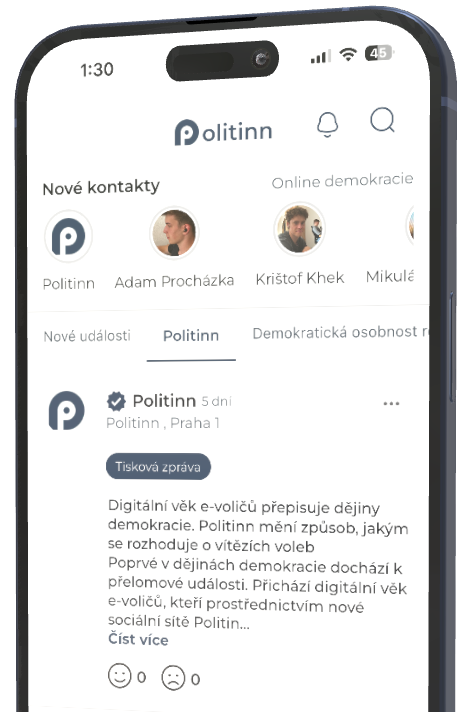



The old model of democracy is ending because it was designed for a world that is past. Cyberspace, where all social and political events are moving, is becoming a major centre of power and influence and a key sphere of governance of modern states, including electoral processes.
Political power will depend on e-voters. Not only will they replace traditional voters, but they no longer have to wait for the official election day to express their support for the politicians they trust most through the social platform Politinn.
The traditional model of democracy has reached a point of systemic exhaustion. In addition, it lacks the necessary technological infrastructure and security mechanisms, without which it is unable to meet the demands of modern society or adequately face the hybrid threats of the 21st century. For the first time in human history, citizens are living in two worlds simultaneously – the physical and the digital – and this new dimension of reality requires entirely new approaches to the protection and governance of society and the state.
In today’s world, the security of citizens and the state cannot be ensured by traditional military force alone; it is absolutely essential to protect digital statehood, sovereignty and state legitimacy in cyberspace, where a key part of modern society, including politicians, concentrates its power and influence.
In the digital age, the traditional model of democracy is losing its legitimacy because it was designed for the real world and is unable to respond adequately to the technological, security, political and social changes of the 21st century. The mechanisms experienced in traditional democracies – power interests, corruption, protectionism, incompetent handling of taxpayers’ funds, bad political decisions that cause problems for citizens and the state, the spread of disinformation and hatred, including manipulation of public opinion – deepen citizens’ distrust of the state and its institutions with each passing day. The greater the distrust in the state and its institutions, the harder it is for citizens to live in the country.
Moreover, current democracy is virtually unworkable for the digital age because it lacks the advanced integrated security systems and cyber protocols necessary to protect digital statehood, state legitimacy, digital infrastructure, and democratic order in cyberspace. It is from this space that the most significant hybrid threats of the 21st century are now penetrating mobile devices, social networks and households, critically threatening the entire democratic world.
The ONLINE DEMOCRACY mobile app, linked to advanced artificial intelligence, represents the most technologically advanced tool for building a modern, effective and stable democratic system, the adoption of which is inevitable for all countries – delayed implementation would critically jeopardize their ability to fully participate in future political and global structures.
Artificial intelligence in the ONLINE DEMOCRACY application represents the technological pillar of the first political system in cyberspace, which streamlines e-communication between citizens and the state in the evaluation and approval of political proposals, optimizes the development of the system, supports the innovative creation of digital political programs, strategic planning and significantly contributes to the preparation of the state budget with all parametric changes. It also ensures control of voting mechanisms and security protocols in e-elections, minimizes the need for traditional political structures, and protects digital statehood and state legitimacy in the cyber future.
For more than 5 billion Internet and social network users, there can only be one ONLINE DEMOCRACY in the digital age. It does not matter whether its form is parliamentary, presidential, semi-presidential, direct or otherwise – new rules apply in cyberspace. Its constitutional pillar is digital statehood and the legitimacy of the state, where citizens as e-voters fully exercise their electoral rights.
The introduction of the principles of digital statehood through the ONLINE DEMOCRACY application, supported by advanced artificial intelligence, represents an evolutionary step towards a safe, efficient and stable governance of the state, appropriate to the technological, security and social conditions of the 21st century. This approach allows for restoring citizens’ trust in democracy and constitutional institutions, preserving the legitimacy, sovereignty and national identity of the state in cyberspace, and strengthening its resilience to hybrid threats, destabilizing influences and cyber-attacks. ONLINE DEMOCRACY combines technological innovation and artificial intelligence with new principles of state governance, bringing public governance into the digital space and promoting effective collaboration between citizens, politicians and government to solve problems, ensuring the continuity, legitimacy and long-term stability of the democratic order.
Definition: Digital statehood protection is a set of measures to ensure the protection of the state, its legitimacy and sovereignty in cyberspace.
Hostile governments are targeting the most vulnerable component of state stability – their cyber armies are penetrating social networks and mobile devices and attacking digital statehood, i.e. sovereignty, institutional authority, territorial identity and democratic legitimacy of the state in the online world. In doing so, they critically undermine citizens’ trust in their own state.
Digital statehood is a modern pillar of national sovereignty and state legitimacy in cyberspace. It is based on the protection of citizens’ trust in the state, its institutions and the democratic process in an environment influenced by new technologies, social networks and artificial intelligence. Without the protection of digital statehood, families, society and the state risk a gradual disintegration due to hybrid threats penetrating from cyberspace into all mobile devices, social networks and households.
The loss of citizens’ trust in the state and its institutions is one of the most feared threats of the 21st century. Without trust, citizens find it increasingly difficult to live in their own country, as their sense of security, justice and belonging to the state disappears. Distrust of the political representation devalues its work, threatens the legitimacy of political parties and movements, and complicates the ability to effectively promote public policies.
The loss of citizens’ trust in the state and its institutions is gradually turning into hatred in society and distorting the security, social, economic, environmental and legal stability of the state. It creates security and social tensions, deepens citizens’ frustration, which translates into escalating conflicts, an increase in extremist attitudes and radicalization of citizens on social networks. It slows down economic development, stifles prosperity and progress, and ultimately causes the disintegration of families and society and the break-up of the state.
The scale of societal distrust in the state and its institutions reveals insufficient state defenses against hybrid threats penetrating mobile devices, social networks and households from cyberspace:
The biggest and most common threat to digital statehood is fake accounts, including those from abroad or bought on black markets. These hybrid accounts increase unrealistic numbers of followers and friends, distort public opinion, threaten national security, online voting, Democratic Personality of the Year nominations, and citizens’ trust in democracy and their own country.
To ensure the protection of the state, its legitimacy and sovereignty in cyberspace, it is essential to establish a dedicated National Security Center for the Protection of Democracy (NSCPD) – without this pillar of national security, the protection of digital statehood would be critically threatened. The Center would replace outdated state authorities focused exclusively on protecting physical space, merge national cyber and security authorities and work partially with intelligence services. It would ensure coordination with international organizations, such as NATO, and other strategic partners.
NSCPD’s primary mission will be to protect and restore trust in democracy, the state and its institutions, and to ensure that hybrid threats infiltrating mobile devices, social networks and households from cyberspace do not disrupt families, society and state structures. This task goes beyond the activities and powers of constitutional officials, individual state bodies, security forces, police, intelligence services and other specialized agencies. It requires the creation and systematic management of an integrated concept of a “Democratic Security Strategy” that assumes super-competence and extraordinary professional capabilities in the areas of reconnaissance, analytical work, risk operations, infiltration into conflict environments, data collection, assurance and verification, vetting of information and people, as well as the development of methods for preventing disinformation and manipulation through artificial intelligence and other advanced digital technologies.
In the digital era, it is essential that the state has an integrated and sophisticated infrastructure to protect its digital statehood that can coordinate prevention, detection and neutralization of threats, analyze the digital environment and protect citizens from manipulation and disinformation. Only by strategically securing digital statehood can we maintain stable and legitimate state institutions, preserve the trust of citizens, ensure a high quality of life, effective public services and the long-term prosperity of society in the 21st century.
“Democracy has its application”
ONLINE DEMOCRACY – the first political system in cyberspace – is a form of government in which the people exercise their power directly through a mobile app. By downloading it on their phones, citizens will gain access to modern technological functions that are an integral part of the digital democratic infrastructure and enable active participation in the governance of the state.
One of the key pillars of the digital democratic infrastructure is e-voting/e-elections. Thanks to the Politinn platform, traditional voters are becoming e-voters who no longer have to wait for the election date and can like – vote online via the ONLINE DEMOCRACY mobile app. Candidates, on the other hand, become e-candidates who can run their election campaigns on the social platform Politinn for free, giving them unlimited space to reach e-voters across the country. This creates a completely new cyber model of the electoral process, which links this infrastructure with an intelligent system of targeted online voting.
Thanks to the ONLINE DEMOCRACY app, which is always at their fingertips on their phones, citizens can immediately express their opinions, react to current political developments, propose their own solutions and actively participate in decision-making. Unlike traditional democracy, where participation and decision-making was limited by annual election cycles, the app puts power directly into citizens’ mobile devices, enabling their immediate, direct and effective participation.
The main objective of the ONLINE DEMOCRACY app is to promote and protect the values that underpin the system, such as human rights, e-elections, e-communication, governance, transparent public reporting, organizing international education of the public about democracy and building digital statehood. The direct participation of citizens creates mutual trust between them and political leaders, which strengthens stability, social cohesion and the quality of interpersonal relations. ONLINE DEMOCRACY also increases the efficiency of government, enables early detection of hybrid threats and promotes fair and morally responsible decision-making. This evolutionary step of digital statehood strengthens the legitimacy of the state, public trust and the resilience of the democratic system, while allowing people to directly influence political processes in real and cyberspace at any time.
The ONLINE DEMOCRACY app represents hope for billions of people living under totalitarian and authoritarian regimes. Citizens will be able to download it on their phones and – for the first time in history – use it to apply the principles of digital statehood and democracy in their own countries where tyranny and lawlessness reign.
Politinn is a social network and the Europe’s first next generation platform originating from the Czech Republic. It is the only one in the world to integrate a digital democratic infrastructure that allows citizens to actively enter the political system of ONLINE DEMOCRACY – there is no other way to enter this system.
In ONLINE DEMOCRACY, e-communication is a key pillar, as its main objective is to provide a space for effective solutions to citizens’ everyday problems. To this end, a digital democratic infrastructure has been built on the Politinn social network, which enables online communication between e-voters and politicians and the public administration.
Poor communication between citizens and politicians leads to a loss of trust in democracy and the rule of law, increased security and social tensions in society, the spread of disinformation and hatred, and the manipulation of public opinion. If in the digital era political communication is still predominantly moderated by traditional media, this is irrefutable proof of the backwardness of the democratic system. The role of traditional media remains indispensable in the cyber future, especially in the area of national and international education of the public about democracy. However, due to the limitations of the media agenda caused by the capacities of editorial offices, this model necessarily fails in an area that is crucial in ONLINE DEMOCRACY – solving everyday problems of citizens through e-communication with politicians and the state administration.
The basic building block of a digital democratic infrastructure is its immunity system, on which not only the development and stability of democracy depends, but also the trust of citizens in its functioning. Without this system, the full, secure and transparent functioning of democratic processes in the digital age would not be possible.
The system ensures safe, fair and open participation of citizens and politicians in e-communication through the Politinn social platform. Its pillars are e-elections, e-voters and e-candidates, who can actively participate in all levels of elections through digital identities. The infrastructure also promotes equal access to political competition, for example through free election campaigns for candidates and political entities without financial background.
The digital democratic infrastructure is designed to be compatible with the emerging digital legal framework, based on the principles of the Digital Constitution, Digital Laws and the Digital Bill of Rights and Freedoms, which will protect civil rights and freedoms in the future online environment. The system also includes integrated security mechanisms, such as the National Security Center for the Protection of Democracy, which protects in particular trust in democracy against hybrid threats, the rise of security and social tensions in society, and the spread of disinformation, hatred and manipulation – mechanisms that penetrate directly into the lives of citizens through social networks, mobile devices and cyberspace.
At the international level, this infrastructure promotes cooperation between democracies, sharing knowledge and strengthening democratic values. An integral part of this is the international education of the public about democracy, represented by the prestigious “Democratic Personality of the Year” award, highlighting the contribution of heroes of democracy who sacrifice their personal and professional lives for democracy and do public good.
The immune system of democracy is a digital organism within which citizens’ everyday problems are shared and meaningful solutions are found through the Politinn social network. Just as the biological immune system protects the body from threats, the democratic immune system protects society and the state from hybrid threats. This system ensures a constant flow of information between citizens, politicians and institutions, thereby strengthening the resilience, transparency and responsiveness of democracy to new challenges.
Here, citizens act as the cells of the democratic organism – with their suggestions, opinions, ideas, visions, and evaluations of politics, they activate the mechanisms that keep democracy healthy, functional, and credible. In this process, the Politinn social network plays the role of a digital nervous system that connects all parts of society in real time. It enables early identification of problems, collective formulation of proposals and immediate feedback, thus preventing the build-up of social tensions and promoting an active and conscious civic culture. Without the immune system of democracy, a democratic state could not exist in the digital age.
An integral part of democracy’s immune system is national education of the public about democracy, in which the heroes of democracy play a key role – ordinary citizens who have won the prestigious “Democratic Personality of the Year” award for their outstanding professional achievements and for acting on behalf of democracy and the public good. These heroes are upstanding pillars in times of hybrid wars and international conflicts, setting an example for their nations and helping to ensure a lasting regeneration of trust, stability and justice.
However, the immune system of democracy cannot be protected by any army, tanks, artillery, missiles, drones or fighter planes. The current hybrid threats – social terrorism – i.e. radicalization of citizens on social networks, digital violence, spreading disinformation and hatred – are penetrating mobile devices, social networks and cyberspace. The protection of this system must be ensured by a modern National Security Center for the Protection of Democracy, which, through prevention, detection and neutralization of threats, strengthens the cyber resilience of the state and society, restores the trust of citizens and guarantees the long-term stability and security of the democratic order.
The state must also be protected in cyberspace.
The state needs to be protected not only in traditional physical space, but also in cyberspace, which has become a new strategic environment during the 21st century with direct implications for the security, stability and very existence of modern democratic states. Ensuring territorial integrity and protecting airspace are no longer enough on their own, because key attacks against the state are now not carried out through tanks or missiles, but through digital technologies, information flows and psychological operations conducted in an online environment.
Cyberspace today effectively creates the virtual borders of the state – an intangible but essential space that has a direct impact on the functioning of state institutions, democratic processes, social cohesion and citizen security. However, this space is not protected, is not clearly defined in the legal order and is not entrusted to any specialized state body with corresponding powers. The state does not yet exercise its sovereignty here, which creates a dangerous security vacuum that is being purposefully exploited by foreign actors.
It is into this unprotected space that hybrid threats carried out by the cyber armies of foreign states enter. These state-controlled digital structures conduct coordinated and long-term operations aimed at destabilizing democratic systems without the use of conventional military force. Through disinformation, hatred, propaganda and manipulation of public opinion, they penetrate directly into the mobile phones, social networks and everyday life of citizens, gradually eroding their perception of reality, trust in the state, its institutions and the democratic establishment itself.
Virtual national borders must therefore be taken as seriously as land, air or sea borders. Their disruption by the cyber armies of foreign states has comparable (and in some cases more serious) consequences than the violation of physical territory. While conventional military aggression is immediately recognizable, hybrid attacks take place covertly, over a long period of time and systematically, often without the society realizing that it has been targeted by a foreign power.
Protecting the virtual borders of the state includes the protection of digital statehood, national identity, digital sovereignty, information integrity, democratic processes and digital rights of citizens. It is about protecting the state’s ability to make autonomous decisions, administer its institutions, and resist the targeted actions of foreign cyber armies whose goal is the long-term disintegration of social cohesion, the weakening of the legitimacy of state power, and the gradual takeover of political influence without direct military confrontation.
It is for this reason that it is necessary to build the National Security Center for the Protection of Democracy (NSCPD) as a new independent pillar of national security. None of the existing security agencies or intelligence services were created to defend the state against hybrid operations conducted by cyber armies of foreign states in the digital and information space. Their mandate and structure are based on the era of protection of physical space and fail to comprehensively respond to the current form of digital aggression.
NSCPD must be created so that the state has a dedicated institution capable of protecting the virtual borders of the state from hybrid operations by cyber armies and restoring citizens’ trust in democracy and state institutions. Without any National Security Centre for the Protection of Democracy, every state in the digital age will remain structurally unprotected and exposed to the cyber armies of foreign states.
Traditional democracy
Traditional democracy is a system based on the election of representatives of the people at predetermined times, where power is concentrated in the hands of political elites and citizens have limited ability to influence decision-making processes. Communication takes place mainly through traditional media and does not allow for continuous participation, which reinforces power structures that are far removed from the real needs of society. This model was created for the physical world and the analogue environment and is gradually losing its effectiveness in the digital age – it cannot respond to the speed of information flows, global connectivity or the need for continuous citizen participation. Without the transformation to an online democratic form, traditional democracy would gradually lose legitimacy and be unable to protect democratic values or provide governance in cyberspace.
E-democracy
E-democracy is a technological extension of traditional democracy, enabling the digitalization of selected electoral and communication processes. It is based on electronic voting (e-elections), where voters can cast their vote using a digital identity. Despite these innovations, e-democracy remains firmly tied to the traditional model – citizen participation is limited to electoral periods and the system does not allow for sustained interaction with political representatives. There is a lack of comprehensive mechanisms for digital communication, education of citizens and protection of democratic values in cyberspace. E-democracy therefore only digitizes existing processes and cannot replace a full-fledged ONLINE DEMOCRACY, which is designed for the everyday participation of citizens, the protection of digital statehood, national sovereignty and state legitimacy in cyberspace.
ONLINE DEMOCRACY
ONLINE DEMOCRACY represents a new civilizational model of governance for the 21st century. It distances itself technologically, legally and institutionally from the traditional system, in which corrupt and inefficient practices persist, undermining citizens’ trust in the state and its institutions. It is based on digital statehood – the highest legal principle for the protection of citizens, the state and its sovereignty in cyberspace. Digital statehood ensures the legitimacy, continuity and stability of the exercise of state power and protects democratic institutions, public administration, decision-making processes, infrastructure and the identity of citizens from cyber-attacks, hybrid threats and foreign interference. It creates a digital democratic infrastructure that allows for continuous interaction between citizens and the state. Citizens become e-voters who can express support, co-determine public issues and control the exercise of power in real time, while e-candidates run transparent campaigns without financial barriers.
Without ONLINE DEMOCRACY and constitutionally enshrined digital statehood, the traditional model would not be able to protect citizens and the state in the digital age, where most threats are transferred from cyberspace to the real world. ONLINE DEMOCRACY is therefore not a modernization of the old system, but a fundamental transformation of political civilization – a new model of participatory governance that ensures the real-time protection of democratic rights, sovereignty and the digital integrity of the state.
Is it possible for politicians to secure a better future for citizens and pursue their program properly without protecting the digital statehood on which citizens’ trust in the state and its institutions depends?
No, it is not possible. Politicians cannot ensure the effective functioning of the state or its security, social, economic, environmental and legal stability, and they cannot guarantee the protection of life, health, basic needs, quality of life or the provision of public services to citizens unless they ensure the protection of digital statehood and the legitimacy of the state in cyberspace. Without this key condition, families, societies and state institutions risk a gradual disintegration due to hybrid threats that penetrate from cyberspace into mobile devices, social networks and households. These threats threaten the integrity of the state, undermine the trust of citizens and limit the ability of state institutions to perform their essential functions.
The most vulnerable and critical component of government politics is the outdated programs of political parties and movements, which is the main reason why citizens’ trust in the state and its institutions is declining. All of these programs lack a crucial security pillar – the protection of digital statehood, national sovereignty and state legitimacy in cyberspace, where political and social communication is shifting and where digital civilization lives.
The programs of political parties and movements are outdated and do not meet key technological parameters or security standards. Without an innovative approach that integrates modern technology and security standards, it is impossible to strategically link political vision with effective management of public funds, optimization of the tax burden and savings for citizens and the state. Only by systematically redesigning them can modern digital political programs emerge, capable of responding to the challenges of the 21st century and ensuring effective, secure and transparent governance of the state even in cyberspace.
Outdated programs prevent effective governance, development, prosperity and progress of the state and complicate strategic planning, coordination of public politics, public financial management, implementation of technological innovation, cyber and information security, educational and scientific programs, infrastructure, transportation and energy systems, environmental protection, social and healthcare services, affordable housing and legislative processes. At the same time, they block the conditions for a superior standard of living and a promising future.
The digital political program is a strategic document that guides society and the state not only in the real world but also in cyberspace. Therefore, it must meet the most stringent security and technological criteria of the 21st century and be constantly updated to predict with maximum accuracy the long-term goals associated with the political vision, implementation of new technologies, artificial intelligence and other innovations. The program also includes medium- and short-term objectives to ensure flexibility, efficient resource management and adaptability to a rapidly changing environment.
At the same time, the digital political program must serve as a tool for active participation of citizens – e-voters should have access to its current versions, they can comment on it, evaluate individual proposals, submit their own initiatives and monitor the progress of implementation. This makes the program a vibrant and transparent governance framework for the state, linking technological innovation, democratic control and the protection of digital statehood.
Their work strengthens transparency in decision-making processes, promotes equality in access to the political process and contributes to the restoration of the moral values of democracy. This innovative model of the electoral process enhances the security, social, economic and legal stability of the state, improves the quality of life of citizens and enables flexible adaptation of government politics to current challenges.
In the traditional form of democracy, it was common for decades for politicians to present their programs to voters without the possibility of immediate feedback. Program points were adopted from above, citizens could not enter, change or influence them, and their role was limited to a single vote every few years. In the period between elections, people were effectively deprived of the opportunity to protect their own interests and decision-making processes took place outside their daily control.
This outdated mechanism today contributes to dissatisfaction in society. Citizens increasingly point out the lack of finances, the high prices of basic necessities, unaffordable housing, inefficient health and social services, or growing tension and hatred between people. In addition, under the influence of disinformation, many people feel disoriented and insecure, because they lose the ability to distinguish truth from manipulation. They often do not realize that one of the main causes of these problems is their long-term inability to actively influence political decisions that directly determine the quality of life and level of well-being.
However, for the first time in history, a fundamental civilizational change is emerging: ONLINE DEMOCRACY. This modern model allows citizens to do what was previously impossible – daily and immediate participation in state governance. The Politinn social network provides people with a tool that allows them to actively respond to politicians' proposals, evaluate individual steps of state administration, discuss, propose their own solutions, vote in real time and protect their interests directly where previously only others decided on them.
ONLINE DEMOCRACY thus becomes a guarantee of well-being, because well-being can no longer be expected from above from politicians or institutions. They cannot guarantee it to anyone if citizens themselves do not participate in shaping the decisions that affect their daily lives. Prosperity arises when people actively participate in political processes, determine state priorities, draw attention to problems, propose solutions and together influence the direction of the country.
It is the Politinn social network that provides citizens with this ability for the first time in history. Here, people can permanently and systematically shape their own future, protect their economic and social interests and influence political developments for the benefit of the entire society. ONLINE DEMOCRACY is a path that allows citizens to transform from passive observers into active co-creators of the state and its prosperity.
Because only when citizens themselves participate in decision-making processes every day through ONLINE DEMOCRACY on the Politinn social network can they ensure stable, sustainable and real prosperity for themselves and future generations. There is no other path to prosperity.
Political power will depend on e-voters: Which e-candidate succeeds in the elections is no longer decided by TV viewers, readers, users or friends on traditional social networks, but only by e-voters on the Politinn platform, who express their online support for those they trust most and put the government in their hands with their likes.
A whole new era of politics is beginning for politicians and traditional candidates – a digital revolution that is changing the very foundations of political careers. The existing models, based on television, the press or conventional social networks, are losing their sense. Traditional media can only make a candidate visible; they show an image, not support. Social networks offer the illusion of popularity, where the number of followers and likes is not a measurable or verifiable force. Popularity is not endorsement and visibility is not legitimacy.
The Politinn platform comes as a revolutionary system change. Here, a candidate no longer builds a career based on a media image or virtual fans, but through real e-voters who express their support directly and measurably. The politician becomes an e-candidate who has to build a new base of e-voters on his/her profile. The only accurate and relevant indicator of his power and chances of a successful career is the number of actual e-voters, a figure that cannot be replaced by millions of followers or hundreds of media appearances.
This transforms the entire political system, from candidacy, to the structure of political entities, to the development of programmes and campaign strategies, to the selection of coalition partners and the long-term political development of the state. E-voters determine the real power of candidates and parties, leading to a new model of legitimacy that is measurable, transparent and resistant to media manipulation. Every step of the political process – from nomination to strategic alliances to policy implementation – is now reflected and verified by direct citizen support.
Political careers thus shift from popularity and media presentation to real democratic legitimacy. Politinn’s digital revolution puts candidates and political parties in a role where legitimacy, trust and political power come directly from citizens, not from media or advertising campaigns. This creates a new, systematically transparent and participatory model of democracy that allows politics to once again serve to address the real problems of society and shape the future political development of the country.
Online expression of trust is a basic function of the immune system of ONLINE DEMOCRACY. The strength of the protection of the state, its digital statehood, national sovereignty and legitimacy in cyberspace depends on the extent to which citizens trust the political system, constitutional institutions, public administration, security forces, courts, military, business and society as a whole. Without this trust, it is impossible to develop democratic institutions, ensure the stability of public processes or build a viable state that is able to withstand hybrid threats, protect national identity and adapt to the technological and societal challenges of the 21st century.
The Politinn platform makes it possible to put this principle into practice. It provides citizens with tools to actively support individual bodies and institutions, participate in shaping public politics, submit proposals, follow updates, and express online trust, thereby linking their participation with the protection of digital statehood and strengthening the legitimacy of the state. This makes democracy a living system of continuous interaction between people, state and institutions. The mechanism integrates innovation, digital technologies and principles of good governance, creating space for transparent, accountable and fair decision-making, while strengthening continuity, stability and the long-term perspective of society as a whole.
The Politinn social network is a unique platform that allows citizens to vote securely and transparently online for political representatives and candidates through a verified digital identity. This principle means that voters do not have to wait for traditional election dates, which represents a complete revolution in the history of politics. Online voting is a key mechanism of ONLINE DEMOCRACY, enabling continuous and meaningful participation of e-voters in the public political sphere.
The strength of the state’s protection, of its digital statehood, national sovereignty and legitimacy in cyberspace is directly derived from the online voting of politicians and candidates. The extent to which citizens support political representatives through e-voting determines a state’s resilience to hybrid threats, its ability to protect national identity and the stability of the democratic order.
The Politinn platform makes this principle possible: e-voters can actively support politicians and candidates, follow updates on their programs, make proposals and express support in real time. The system integrates technological innovations, security standards and principles of good governance, creates space for transparent, accountable and fair decision-making and strengthens the continuity, stability and long-term perspective of society.
Online voting for politicians and candidates is not a mere digitization of traditional elections, but a transformative mechanism of modern democracy that ensures the protection of the legitimacy, sovereignty and digital statehood of the state and allows citizens to become true co-creators of the democratic process.
One of the most important events of our time is the annual celebration of International Democracy Day on 15 September, which aims to raise awareness of the importance of democracy, trust and civic responsibility. A key role in this process is played by the Politinn social platform, the sole organizer of the prestigious “Democratic Personality of the Year” award, which is given directly by citizens – users of the platform.
This award is given to heroes of democracy for their commitment to the protection and development of democracy and for their actions for the public good. It symbolizes the highest national honor, deep respect and social prestige. Each laureate becomes an example of defending democratic values, strengthening trust in institutions and making an irreplaceable contribution to society and the state.
The nominations are awarded by citizens to those personalities who contribute to the development of society in the fields of education, healthcare, security, science, culture, media, sport, law, business, environmental protection or political activity through their actions, work and civic engagement.
On the day of the celebrations, a gala evening is held with the participation of prominent political and public figures, representatives of the EU, international institutions and foreign guests, who have the honor of presenting awards to the heroes of democracy. This event symbolically links public recognition of citizens to the global celebration of democracy, inspires active protection of democratic values, and affirms that a true hero of democracy protects the public good and strengthens the pillars of trust, truthfulness and civic cohesion – essential for a vibrant and resilient democracy.
International education of the public about democracy is a key pillar in protecting freedom, human rights and stability of modern states, especially in the era of growing hybrid threats to digital statehood, national sovereignty and state legitimacy in cyberspace. In the digital age, when billions of citizens spend a significant part of their lives online, it becomes necessary to develop the ability of information self-defense, to defend against digital violence, manipulation and social terrorism.
The aim of international education of the public about democracy is to promote democratic values, ethics and education, to strengthen interpersonal and virtual relations and to restore citizens’ trust in democratic institutions. At the same time, it provides people with knowledge about their rights, opportunities for participation and tools to actively protect freedom, the environment and the public good. This process is essential for the billions of people who face authoritarian regimes, censorship and oppression in their countries – giving them the inspiration, support and courage to engage civically and defend democracy.
In addition to protecting human rights and freedoms, international education of the public about democracy contributes to economic stability, security and peaceful coexistence, as informed citizens are better able to recognize propaganda and communicate and cooperate effectively to solve complex global problems. It supports the emergence of a modern society based on respect, transparency, justice and accountability.
International education of the public about democracy provides a solid foundation for a digital civilization in which individuals can actively influence political, social and economic processes, protect their freedoms and contribute to a safer, fairer and more sustainable future. This process is thus becoming a strategic tool for safeguarding democracy, the stability of states and the sustainable development of human society in the digital age.
ONLINE DEMOCRACY represents the greatest civilizing event in human history – the world's first political system to exist entirely in cyberspace. This historic breakthrough allows the entire digital civilization – more than five billion internet and social network users – to actively engage for the first time, while providing an unprecedented opportunity to protect digital statehood, national sovereignty and state legitimacy through the digital democratic infrastructure built by the Politinn social network.
Thanks to this historic advantage, citizens around the world can download the ONLINE DEMOCRACY mobile app on their phones and become full participants in the democratic process. They can thus directly influence public, political and social life in real time, without time, space or financial constraints.
ONLINE DEMOCRACY transforms traditional political structures and replaces them with a transparent, inclusive and technologically secure form of governance. It strengthens trust, legal certainty, social cohesion and economic development, creating a stable framework for a sustainable future for modern states. This concept has the support of the European Union and the United States, which have long advocated digital participation, open government and the protection of democracy in the online space.
ONLINE DEMOCRACY is not just a tool for the administration of public policy – it represents a global revolution in political thinking, linking technological civilization with democratic principles and enabling citizens of all countries to create, develop and protect democracy together in the digital age.
For the first time in history, e-voters – i.e. citizens and taxpayers – are able to have continuous, transparent and publicly accessible oversight of the use of public funds through the Politinn social platform. This system represents a major step forward in civilization, where people can monitor in real time the use of the state budget, the results of public investments and the economy of individual chapters.
Politicians, ministries and public institutions are obliged to provide open and up-to-date access to information on funding – from investments and public procurement to subsidies and operating costs. Each item becomes part of a digital system of public scrutiny, evaluation and suggestions for improvement that limits the scope for corruption, clientelism or inefficient decision-making.
Thanks to this model, e-voters can highlight inefficient spending, suggest savings and improve the efficiency of the state's management. Active participation of citizens not only strengthens the stability and transparency of the state administration, but above all ensures the protection of digital statehood and strengthens citizens’ trust in democratic institutions, which is a key prerequisite for a resilient and viable state.
ONLINE DEMOCRACY creates a new political, legal and financial framework where people can protect public interests, promote responsible governance and contribute to the prosperity of society through e-voting. E-voters thus become the real guardians of the treasury, and the Politinn platform provides a tool to ensure the protection of digital statehood, national sovereignty and the legitimacy of the state in cyberspace by trusting citizens.
“Heart for the Nation” is a key component of ONLINE DEMOCRACY and its immune system that ensures the stability and resilience of the state. Digital statehood cannot be separated from love and care for the nation – anyone who does not care for his nation cannot be a true citizen.
The Politinn social network allows citizens to share their stories, experiences, suggestions and activities, thereby actively contributing to the development of society, strengthening national identity and cultural heritage. This sharing is not just a symbol of pride, but an essential part of the digital immunity system of democracy that protects the trust, cohesion and transparency of society.
For the first time in history, it is possible to systematically develop national traditions, values and customs not only in the real world, but especially in cyberspace, where more than five billion users live. Active participation of citizens through online tools strengthens interpersonal relations, transmits values to the next generation and ensures the long-term stability of the democratic system.
“Heart for the Nation” connects the personal engagement of each individual with the protection and development of digital statehood, strengthening trust in democracy and enabling ONLINE DEMOCRACY to thrive, protecting national identity and securing the future of the state.
Public reporting is a fundamental pillar of ONLINE DEMOCRACY and the most effective tool for protecting digital statehood and citizens’ trust in the state and its institutions. Through the Politinn social network, equipped with a fully integrated digital democratic infrastructure, citizens receive comprehensive, verified and continuously updated information on the activities of politicians, public administration, state authorities, local government authorities, hospitals, schools, police, military and other public institutions.
This system allows citizens to keep track of current decisions, investments, public procurement and other activities that affect their daily lives, and provides a unique tool for strengthening transparency and accountability of public officials. Public reporting thus ensures that every citizen can have an overview of the activities of the state apparatus, evaluate them and actively support the protection of the public interest through digital tools.
It is not only about information – public reporting is a historic breakthrough in state governance because it combines ethics, accountability and transparency with active e-voter participation. Every citizen becomes part of the immune system of democracy, contributes to the protection of digital statehood, strengthens trust in institutions and consolidates the stability of the state.
Public reporting therefore represents the highest form of democratic engagement: it provides citizens with the power to protect their state, promote efficient management and transparent governance, thereby ensuring the long-term viability and resilience of the democratic order in the digital age.
ONLINE DEMOCRACY must be legally enshrined in the Constitution to protect digital statehood, sovereignty and state legitimacy in cyberspace. The state is obliged to define and implement digital statehood mechanisms that enable citizens to exercise their democratic rights in a secure, free and transparent manner in the digital environment. Constitutional anchoring also ensures that the institutions of the state – the President of the Republic, the Parliament, the Senate, the Government, the judiciary, the security forces, schools, hospitals and the public media – maintain their credibility, authority and continuity.
Such a framework is necessary to prevent and protect against hybrid threats, cyber-attacks and disinformation campaigns that threaten the trust of citizens, the stability of state power and the security of society.
In order to effectively protect digital statehood, it is necessary to adopt digital legislation that clearly defines the competences of state bodies, the rights and obligations of citizens, rules for e-voting, registration of e-voters and e-candidates, transparent presentation of political proposals and secure participation of citizens in decision-making processes. This legislation must also protect the state and its citizens from the spread of disinformation, manipulation and abuse of cyberspace against democratic institutions.
ONLINE DEMOCRACY is the first digital political system that connects citizens, institutions and modern technologies into a unified and secure governance framework. The legal anchoring of this system ensures that every citizen can actively participate in public issues, submit candidacies, initiate referenda and control the activities of state institutions.
ONLINE DEMOCRACY is thus an essential part of a modern democratic state and its constitution. It aims to ensure that power truly comes from the people, that the institutions of the state are transparent, accountable and trustworthy, and that every citizen can exercise their democratic right safely and responsibly in the digital space.
Digital statehood and the legitimacy of the state thus become fundamental pillars of stability, resilience and trust in modern democracy in the 21st century.
This event marks a historic milestone for democracy and citizen engagement in the digital age. For the first time in history, politicians have the opportunity to submit their policy proposals directly to e-voters, who can not only support them with their votes in the form of “likes”, but also enrich them with their own suggestions, comments and innovative proposals. Policy proposals supported by e-voters allow for a clear mandate from citizens, which gives politicians more legitimacy and power when implementing decisions.
This direct flow of feedback between citizens and politicians is a revolutionary step towards open, transparent and accountable democracy. Policy proposals supported by e-voters increase citizen engagement and awareness, making their role in public life active and meaningful.
A new feature on the Politinn social platform, which allows for the submission of political proposals directly to e-voters, introduces modern CivicTech tools to ensure efficient sharing and management of proposals, their rapid submission, clear evaluation and supplementation with feedback from citizens. This model strengthens democratic principles while increasing public trust in political institutions.
Historically, e-voter-enabled policy proposals are ushering in a new era in which citizens and government are collaborating to an unprecedented degree. This moment sets a new standard for public governance, political accountability and active citizen participation, and shows that democracy is alive, interactive and shared, not a mere formality.